 In a press release today the Government of Sikkim have announced that His Holiness the Gyalwang Karmapa has will visit Phodong Monastery in Northern Sikkim next year. The decision came after talks between Shri Rahoul Ghandi, and senior members of the Sikkim Pradesh Congress Committee. Phodong belongs to the Kagyupa School of Buddhism, and is thought to be the one of the oldest monasteries in Sikkim.
Sunday, 24 November 2013
HH Gyalwang Karmapa for Sikkim 2014
In a press release today the Government of Sikkim have announced that His Holiness the Gyalwang Karmapa has will visit Phodong Monastery in Northern Sikkim next year. The decision came after talks between Shri Rahoul Ghandi, and senior members of the Sikkim Pradesh Congress Committee. Phodong belongs to the Kagyupa School of Buddhism, and is thought to be the one of the oldest monasteries in Sikkim. 


Thursday, 17 October 2013
Ringu Tulku's Message of Condolence after the Death of Choje Akong Rinpoche, the founder of Samye Ling Monastery.
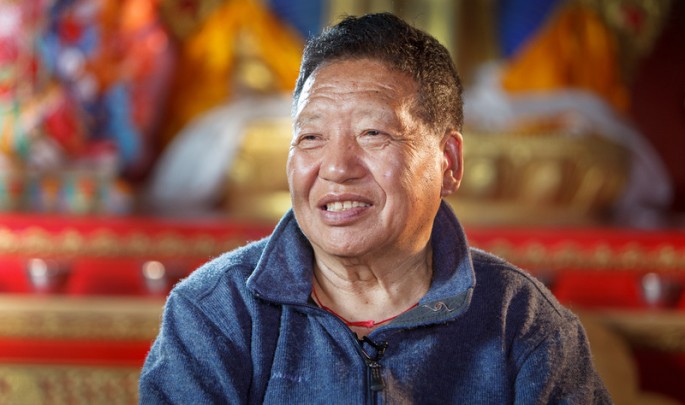
I am shocked and shattered to know that Choje Akong Tulku Rinpoche has passed away at the hands of murderers in Chengdu on 8th of October along with his nephew and driver. I feel so helpless and lonely without his strong and courageous presence.
I knew Akong Rinpoche since I was 9 years old. He bathed me when I was dirty and nursed me when I was sick. He has been a most reliable and constant friend all my life. He was also the first to invite me to come to the West to teach.
Akong Rinpoche was a man of few words and he always did what he said. I never saw him sitting idle even for a short period and he was always doing something worthwhile. But with same ease and naturalness.
He never looked stressed or tense.
He taught us that to help the helpless is the essence of Dharma practice as well as our human responsibility. We will always miss him but I hope his mission would never come to suffer because of his absence.
I would like to pray for his swift return and to continue to help countless people who need dedicated and fearless people like him.
Ringu Tulku
Monday, 9 September 2013
A response to this years Dublin Hilton teachings from Lisa Tully
The
Convenient Truth I Learned From a Buddhist Master
“Beware the
barrenness of a busy life.” ~ Socrates
Are you
running around in search of that holy grail of inner peace?
Maybe you are
so busy in search of it you pass yourself out? Well, I came across an
incredible, kind and charismatic teacher that taught me a thing or two about
this kind of behaviour and where the real wealth lies.
This weekend
I attended teachings with the Tibetan Buddhist master Ringu Tulku Rinpoche at the Hitlon
Hotel in Kilmainham, Dublin. A long name with lots of confusing titles so
let me explain it a bit for you.
 The term tulku is for an enlightened being who
decided at the time of death to be reborn as a human; they come back to
continue their work helping confused folks—like you and me—who are stuck in the
dramas of samsara. They choose to do this rather than stay in what could be
described as a type of Buddhist heaven. Another type of tulku is a person who has certain
characteristics of an enlightened being. Generally, people like the Dalai Lama
recognize them and give them their title.
The term tulku is for an enlightened being who
decided at the time of death to be reborn as a human; they come back to
continue their work helping confused folks—like you and me—who are stuck in the
dramas of samsara. They choose to do this rather than stay in what could be
described as a type of Buddhist heaven. Another type of tulku is a person who has certain
characteristics of an enlightened being. Generally, people like the Dalai Lama
recognize them and give them their title.
The title Rinpoche is an honorific title
automatically given to tulkus, and high-level teachers can earn it over time.
In other words, if you are lucky enough to attend teachings by someone named as
Tulku Rinpoche, who is within a reputable monastery or lineage, then chances
are you should really pay attention. They could have the key to finding that
holy grail of inner peace.
If I am being
honest, there are some Rinpoches that I gel with instantly and some that I just
don’t. I always used to wonder about that until this weekend. Ringu Tulku told
a story about how a student went to a high-level master asking for meditation
instructions, but the master told him to go to one of his students instead, as
they had a better karmic connection.
That
resonated with me and made me feel at ease for not being so enamored with some
masters. My guilty conscience was set free!! (I was raised Irish Catholic, so
guilt is my hangover from that period. I actually heard a great turn of phrase
last week when chatting to an Irish American from Chicago. He called himself a
‘recovering Catholic’…I second that!)
Tibetan
Buddhism can be a complex thing with very deep teachings that go straight over
my head. So, when during a particularly heavy teaching Ringu Tulku put down his
book and admitted he used to know this stuff but didn’t anymore, I was once
again put at ease. He went on to explain how he had learned it by heart for
exams, but once the exams were over he did a brain dump and never looked back.
He then
proceeded to turn the teachings around and go back to his easy style of
teaching through analogy and stories, answering our basic questions around our
internal struggles and the practice meditation. It was gold dust and I felt
very blessed to be there.
 When I
reflect on it, there were two teachings that really stayed with me that I would
like to share in the hope that it be of benefit to you also.
When I
reflect on it, there were two teachings that really stayed with me that I would
like to share in the hope that it be of benefit to you also.
Firstly, he
said we are all like poor people sleeping on top of a treasure unbeknownst to
ourselves—and that treasure is our inherent Buddha nature.
But rather
than recognizing that, we occupy ourselves with things to do in search of it!
Priceless wisdom, don’t you think?
The second
teaching he delivered through a story that a child told him and it goes like
this: There were three monsters and they wanted to take away the happiness of
all people. Deciding where the best place would be to hide it, the first
monster suggested at the bottom of the sea. The other monsters said that
wouldn’t work, for people would just keep digging till they found it.
The second
monster then suggested they hide it in the sky, far away in the galaxy; but,
again, the others said mankind would find it for they would keep sending space
ships up to search for it till it was uncovered.
Then the
third monster said he had the perfect place to hide the happiness of mankind,
for it is the only place they will never
look—inside their hearts.
That struck
such a deep cord with me, for I believe it to be true. On my personal journey
of meditation and self-exploration, I have come up against resistance from
those that claim to love me. My choice to explore and find that happiness by exploring
my heart space has terrified these people. I honestly think it does the
majority of people and that is a real tragedy.
To believe
that doing this kind of work will bring more pain is like the poor man
ignorantly sleeping on top of the treasure, for it is quite the opposite. Our
hearts are that Holy Grail. They are the riches
we sleep on every night without realizing it.
 |
| Rinpoche with some of his Irish students in India |
To really explore the
terrain of the heart I think we need help. We need to find someone who can help
us see our own blind spots, who will be our lighthouse in the storm, who will
impart their wisdom on to us.
That someone
can be a therapist, a Buddhist master, a spiritual teacher or anyone else you
personally find—for when the student is ready, the teacher always appears. And to help
them help you, meditation is the magic ingredient; it will make you strong
enough to follow through on their guidance.
Ringu Tulku
shared something along those lines too. He said that the only three things we
need to achieve lasting peace are meditation, wisdom and the right kind of
lifestyle. In other words, if we are a bank robber that will disturb our peace
of mind for fear of being caught and we won’t be able to meditate.
Start to
meditate. Allow someone into your life who can share their wisdom
with you until you harness your own. Finally, live a lifestyle that allows you
to go in and find the true happiness that is the treasure of your heart.
Author Lisa Tully Lisa runs spiritual tours to India. Taking
people to attend teachings by the Dalai Lama & learn meditation, she does
this work to open hearts and expand minds. She also takes people into the
shamanic world of Tibetan Buddhism & their future predicting oracles. Visit
her & join up to her newsletter at Spiritual Quest Adventures.
Wednesday, 24 July 2013
Rinpoche has a dedicated page on the Shambhala Publications website
Shambhala Publications have given Ringu Tulku Rinpoche a dedicated page with links to Bodhicharya on their website coinciding with the publication last summer of 'Confusion Arises as Wisdom'.
This book is the result of a series of teachings that Rinpoche gave across Europe on 'Gampopa's Teachings on the Great Assembly' over a number of visits, including here in Ireland. It was edited by Ann Helm, who also worked very closely with Ringu Tulku to translate and edit his book on Rimé, also available from Shambhala.
 "The Tibetan Buddhist teachings on the freedom that comes from perceiving the emptiness of all phenomena—teachings known collectively by the name Mahamudra—are presented here with remarkable clarity through commentary on a twelfth-century text. The text is "Gampopa's Great Teachings to the Assembly," by Gampopa, the foremost disciple of the legendary figure Milarepa and founder of Tibetan Buddhism's Kagyu school. The commentary is by Ringu Tulku Rinpoche, a contemporary teacher of deep learning and profound practice with a remarkable gift for presenting these traditional teachings in a way that is accessible to Western hearts and minds.
Gampopa in his teaching combined the general Mahayana teachings he received from the Kadampa tradition of Atisha with the quintessential Vajrayana teachings, which he received from his teacher, Milarepa. These became the basis of the Kagyu lineage teachings that he founded. This particular text, which includes both Mahayana and Vajrayana teachings, is representative of the classic teachings of the Kagyu tradition in general".
"The Tibetan Buddhist teachings on the freedom that comes from perceiving the emptiness of all phenomena—teachings known collectively by the name Mahamudra—are presented here with remarkable clarity through commentary on a twelfth-century text. The text is "Gampopa's Great Teachings to the Assembly," by Gampopa, the foremost disciple of the legendary figure Milarepa and founder of Tibetan Buddhism's Kagyu school. The commentary is by Ringu Tulku Rinpoche, a contemporary teacher of deep learning and profound practice with a remarkable gift for presenting these traditional teachings in a way that is accessible to Western hearts and minds.
Gampopa in his teaching combined the general Mahayana teachings he received from the Kadampa tradition of Atisha with the quintessential Vajrayana teachings, which he received from his teacher, Milarepa. These became the basis of the Kagyu lineage teachings that he founded. This particular text, which includes both Mahayana and Vajrayana teachings, is representative of the classic teachings of the Kagyu tradition in general".
Nikko Odiseos Director of Shambhala Publications, wrote to Rinpoche prior to the launch of 'Confusion Arises as Wisdom' :
'I also wanted to reach out and say how excited we are about Confusion Arises as Wisdom coming out soon. Your editor, Dave O’Neil, who has been at Shambhala nearly a quarter century was raving – much more than usual – about how wonderful it is and the clarity of your presentation.'
This book is the result of a series of teachings that Rinpoche gave across Europe on 'Gampopa's Teachings on the Great Assembly' over a number of visits, including here in Ireland. It was edited by Ann Helm, who also worked very closely with Ringu Tulku to translate and edit his book on Rimé, also available from Shambhala.
"The Tibetan Buddhist teachings on the freedom that comes from perceiving the emptiness of all phenomena—teachings known collectively by the name Mahamudra—are presented here with remarkable clarity through commentary on a twelfth-century text. The text is "Gampopa's Great Teachings to the Assembly," by Gampopa, the foremost disciple of the legendary figure Milarepa and founder of Tibetan Buddhism's Kagyu school. The commentary is by Ringu Tulku Rinpoche, a contemporary teacher of deep learning and profound practice with a remarkable gift for presenting these traditional teachings in a way that is accessible to Western hearts and minds. Nikko Odiseos Director of Shambhala Publications, wrote to Rinpoche prior to the launch of 'Confusion Arises as Wisdom' :
'I also wanted to reach out and say how excited we are about Confusion Arises as Wisdom coming out soon. Your editor, Dave O’Neil, who has been at Shambhala nearly a quarter century was raving – much more than usual – about how wonderful it is and the clarity of your presentation.'
Saturday, 6 July 2013
Rinpoche's Dublin visit

See last posts below for details.
Wednesday, 12 June 2013
Meditation: What’s the Point?

Saturday 6th July at 2-5pm
Hilton Kilmainham Hotel, Inchicore Road, Dublin 8
Booking not necessary. Donations at the door will go to support Ringu Tulku’s various charity projects.
As part of Ringu Tulku’s annual teaching visit to Ireland this year, Bodhicharya Ireland are hosting a public talk on Saturday 6th July on the topic of 'Meditation: What’s the point?'.
Ringu Tulku’s words take us directly and in a lighthearted way to the point of Buddhist meditation -
“It helps to develop the two positive life enhancing qualities that lie naturally within us: clarity of mind and kindness for self and others”.
And, he says, it is through meditation we can come to understand how the interconnectedness of all things is crucial for human well-being and for the future of the planet.
No fuss or frills, it is as simple as that. The methods for practice are relaxed and straightforward, the logic is clear, and the result is peace of mind.
But, Is it relevant to the busy, modern global citizen of the 21st century or is it simply something from a mythical Asian past? What use is it to us, now, here, in Dublin, with our busy lives, protracted recession, disappointing politics and our disgruntled and emigrating youth?
Intended to be a frank and practical discussion on the benefits of meditation and how it can help us directly, this short informal talk in the comfortable surrounds of the Hilton in Kilmainham, is open to everyone and hopes to offer a wonderful introduction to the subject.
There will be a 30 min tea break in the middle and towards the end of the talk there will be the opportunity for the members of the audience to ask Ringu Tulku questions.
The following day we will continue with a Buddhist teaching from Ringu Tulku on the topic of Science and the Mind. Anyone who enjoyed the public talk is very welcome to join us for this too.
No need to book.
Friday, 7 June 2013
Teachings on the Abhidharma: A Science of Mind.
Investigating how we create our reality through the Five Skandhas.
Booking not necessary. Donations at the door will go to support Ringu Tulku’s various charity projects.
Creating chaos is the habit of an untrained mind. Teachings on the Abhidharma investigate the workings of the mind and human consciousness and explain how we come to develop a sense of 'self'. Using a commentary by Jamgon Mipham Rinpoche, 'The Gateway to Knowledge', [Vol 1], Ringu Tulku will explain the Five Skhandas or Aggregates, which describe the ways we create our lived reality and relationship with the world.
The 'Tripitaka' or 'Three Baskets', is the name given to the entirety of the teachings of Shakyamuni Buddha, the first being the Sutras, or sermons; the second is the Vinaya, which gives the guidelines for personal conduct on the path to realisation.
Sunday 7th July at 9.30am
Hilton Kilmainham Hotel, Inchicore Road, Dublin 8
Booking not necessary. Donations at the door will go to support Ringu Tulku’s various charity projects.
Creating chaos is the habit of an untrained mind. Teachings on the Abhidharma investigate the workings of the mind and human consciousness and explain how we come to develop a sense of 'self'. Using a commentary by Jamgon Mipham Rinpoche, 'The Gateway to Knowledge', [Vol 1], Ringu Tulku will explain the Five Skhandas or Aggregates, which describe the ways we create our lived reality and relationship with the world.
The 'Tripitaka' or 'Three Baskets', is the name given to the entirety of the teachings of Shakyamuni Buddha, the first being the Sutras, or sermons; the second is the Vinaya, which gives the guidelines for personal conduct on the path to realisation.
These teachings on Abhidharma are the third level or 'Basket' and provide a scientific and philosophical discourse of the previous two. They are often considered to represent the psychology of Buddhism, and are as relevant to the evolution of contemporary society as they were over 2,500 years ago; addressing amongst other things the basis for best practise in education, relationship, environmental issues, and outlining how wisdom, compassion and mindfulness are crucial for the future of our civilisation.
These teachings will also be open to those who attend the Saturday public talk.
 Hilton Hotel, Kilmainham, Dublin 8
Doors open 9 am for 9.30 am start
Lunch 12.30 - 2 pm
Close 4.30 pm
There will be coffee / tea breaks in the morning and afternoon.
Suggested donation €40 for the day.
These teachings will also be open to those who attend the Saturday public talk.
 Hilton Hotel, Kilmainham, Dublin 8
 Doors open 9 am for 9.30 am start
Lunch 12.30 - 2 pm
Close 4.30 pm
There will be coffee / tea breaks in the morning and afternoon.
Suggested donation €40 for the day.
Everyone is welcome to join Ringu Tulku for lunch at the Hilton Hotel, Kilmainham on the Sunday.
Subscribe to:
Posts (Atom)